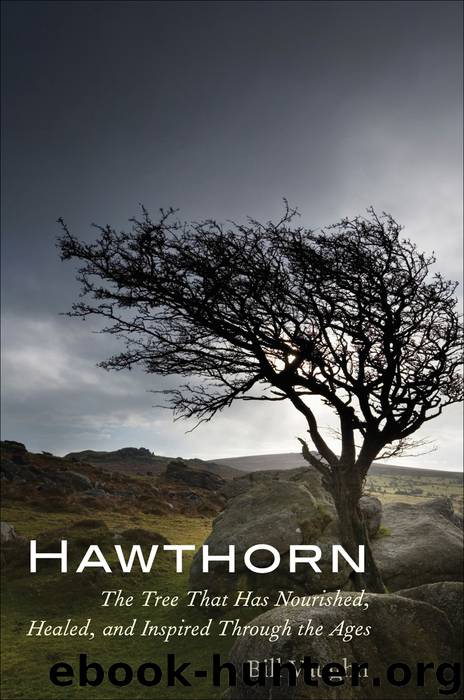
Hawthorn by Bill Vaughn
Author:Bill Vaughn
Language: eng
Format: epub
Publisher: Yale University Press
Published: 2015-07-26T16:00:00+00:00
NINE
A Tree for All Seasons
More grass means less forest; more forest less grass. But either-or is a construction more deeply woven into our culture than into nature, where even antagonists depend on one another and the liveliest places are the edges, the in-betweens or both-ands. . . . Relations are what matter most, and the health of the cultivated turns on the health of the wild.
—MICHAEL POLLAN
On bright summer mornings there’s so much birdsong streaming from the canopy at Dark Acres the place sounds like a tropical rain forest. This stretch of timber, grassland, slough, and shore we share with another couple got its name because by late afternoon it’s cast in deep shadows thrown by the Bitterroot Range on the left bank of the Clark Fork. Towering ponderosa pines and black cottonwoods define the overstory; the understory is dominated by Douglas hawthorns, willows, water birch, and red osier dogwood. Only twenty-three acres in area, in volume this enormous aviary is twice the size of the old Houston Astrodome, a sanctuary in a spreading exurban landscape, never logged or farmed.
While there are 165 species of birds native to our region, I’d become curious about how many individual birds were actually in attendance here on a typical day. Certainly dozens, maybe scores. Could there be hundreds? I had assumed a census would be impossible because birds come and go as they please. But I learned that there is a way to count them—two ways, actually—if you have the patience and the expertise. The first method is the fixed radius point count. Several trained observers place themselves in the centers of imaginary circles with a radius of, say, a hundred yards, and write down all the birds inside the circles they see and hear for a fixed period of time, usually five or ten minutes. Then, often using GPS devices to navigate, they move to other spots in the centers of circles whose circumferences touch that of the first circles. And so on. This method yields a list of species present on a finite piece of ground on a given day, and a reasonably accurate estimate of their numbers. Of course, the more observers the more reliable the numbers.
Just after dawn on an August morning, volunteers from the Five Valleys Audubon Society arrived at Dark Acres. Led by Jim Brown, a retired Forest Service specialist in wildland fires, the four researchers soon set off into the floodplain using a deviceless survey called the transect method. Walking together as a foursome for three hours along our game trails, they compiled sightings and soundings to produce a ballpark inventory of the kinds of birds at Dark Acres and their numbers. On this morning (mornings are the best time to count birds because they’re active: hungry and not yet affected by the rising heat), they counted thirty-seven species, ranging from a Sandhill crane and a pair of bald eagles to a pileated woodpecker and a gray catbird. The birds they were most excited about were the nine Lewis’s woodpeckers they saw.
Download
This site does not store any files on its server. We only index and link to content provided by other sites. Please contact the content providers to delete copyright contents if any and email us, we'll remove relevant links or contents immediately.
Sapiens: A Brief History of Humankind by Yuval Noah Harari(14376)
The Tidewater Tales by John Barth(12656)
Mastermind: How to Think Like Sherlock Holmes by Maria Konnikova(7331)
Do No Harm Stories of Life, Death and Brain Surgery by Henry Marsh(6940)
The Thirst by Nesbo Jo(6937)
Why We Sleep: Unlocking the Power of Sleep and Dreams by Matthew Walker(6708)
Life 3.0: Being Human in the Age of Artificial Intelligence by Tegmark Max(5552)
Sapiens by Yuval Noah Harari(5368)
The Body: A Guide for Occupants by Bill Bryson(5088)
The Longevity Diet by Valter Longo(5060)
The Rules Do Not Apply by Ariel Levy(4961)
The Immortal Life of Henrietta Lacks by Rebecca Skloot(4582)
Animal Frequency by Melissa Alvarez(4467)
Why We Sleep by Matthew Walker(4436)
The Hacking of the American Mind by Robert H. Lustig(4379)
Yoga Anatomy by Kaminoff Leslie(4359)
All Creatures Great and Small by James Herriot(4314)
Double Down (Diary of a Wimpy Kid Book 11) by Jeff Kinney(4266)
Embedded Programming with Modern C++ Cookbook by Igor Viarheichyk(4175)
